ITV visits a Chengdu bar where traditional Chinese medicine consultations inform cocktails containing herbal ingredients. The report places these venues within young consumers’ competing desires for nightlife and self-care, alongside China’s expanding nighttime economy.
Chinese cocktail bars are combining pulse assessments with drinks containing herbs associated with traditional medicine. The article presents these venues as part of a youth trend that pairs nightlife with attempts at self-care amid work-related stress.
VICE explains Chinese “barmacies,” where traditional medicine consultations are paired with personalized herbal cocktails. Drawing on other reporting, it frames their appeal through the contradiction of seeking wellness while maintaining indulgent lifestyles.
The article explores Chinese Gen Z’s interest in bars that combine traditional medicine consultations with personalized herbal cocktails. It connects this tension between indulgence and wellness to demanding working lives and discusses related botanical-drink trends abroad.
The report describes Chinese bars where practitioners assess customers before bartenders prepare herbal cocktails. It links their appeal to stressed young adults seeking leisure alongside health rituals, while distinguishing the venues’ wellness positioning from medical treatment.
Punk Wellness describes a self-ironic approach to the contradictions between health-conscious intentions and everyday habits. Its Chinese expression, 朋克养生, pairs the language of rebellion with an older tradition of nourishing life. Familiar examples include putting goji berries in a thermos while staying up late, or using a face mask after an all-nighter. The interest lies in the contradiction, not in evidence that one practice cancels another.
It is better understood as a cultural phenomenon than as a unified movement, prescribed lifestyle or medical system. PunkWellness.org adopts the term for an editorial project, but did not invent it. Coverage should distinguish the broader Chinese phenomenon from this particular project's interpretation. Neither is a substitute for health advice.
02
Where and how did the phenomenon originate?
The term spread on Chinese social media in the late 2010s, particularly in discussions of young urban workers and their contradictory routines. Images and jokes brought together practices associated with health preservation and habits associated with demanding work or nightlife. A thermos containing goji berries alongside a late working night became an especially legible expression of that tension.
The context includes long working hours, burnout and debates around “996”: working from nine in the morning until nine at night, six days a week. These conditions help explain the humour without accounting for every participant's experience. There is no basis here for identifying a single inventor, founding event or organisation. The Barcelona-based PunkWellness.org initiative followed in 2026; it was not the phenomenon's origin.
03
What does 朋克养生 mean in Chinese?
朋克养生 is transliterated as péngkè yǎngshēng. 朋克 means “punk”, while 养生 means “nourishing life”, a classical Chinese concept concerned with preserving health and cultivating everyday ways of living. Combining them creates a deliberately incongruous expression: rebellion sits beside care, and disregard for routines sits beside concern about their consequences. “Punk Wellness” is a useful English rendering, although it cannot carry every association of the Chinese phrase.
In this usage, “punk” does not necessarily identify a musical allegiance, political position or membership of a subculture. The phrase often works as a joke about inconsistent behaviour rather than a declaration of identity. Likewise, yangsheng is broader than adding herbs to drinks. The expression should not be translated into a claim that traditional ingredients neutralise unhealthy habits.
04
Why is the movement especially relevant to younger generations?
The phenomenon offers a vocabulary for younger people negotiating demanding schedules, economic pressures and expectations of constant self-improvement. In the Chinese context, discussion of long working hours and burnout gives the jokes a particular social setting. Wanting rest or care while continuing to work late is not simply an individual failure of discipline; it can also reveal the limits of personal choice within demanding routines.
Self-irony makes these contradictions easy to share online without adopting the authority of a wellness expert. However, “younger generations” is not a single audience, and the available context does not establish how many people identify with the term. Journalists should avoid turning a recognisable social-media expression into a universal portrait of Chinese youth, or assuming that everyone involved endorses the same habits.
05
What does “Wreck Yourself. Save Yourself.” mean?
“Wreck Yourself. Save Yourself.” is the opening slogan of the PunkWellness.org manifesto. It compresses the project's interest in conflicting impulses: seeking intensity, sociability and freedom while also wanting discipline, rest and care. Its force is rhetorical, deliberately departing from the polished language associated with some wellness branding. It is not a literal instruction to injure oneself or a factual promise that damage can be reversed.
The wording needs context, especially when quoted on its own. Training, herbal ingredients and recovery routines do not cancel the harms of alcohol or tobacco. The slogan belongs to the project's cultural framing rather than to the historical definition of every use of 朋克养生. Reporting should identify whose words these are and distinguish expressive language from medical advice or evidence.
06
How is Punk Wellness different from conventional wellness?
Punk Wellness foregrounds inconsistency rather than presenting an ideal of seamless self-control. Where some wellness messaging emphasises purity, optimisation and visibly disciplined routines, this cultural expression makes room for humour about failing to follow those ideals. Its examples often place a caring gesture beside a habit that undermines the intention behind it. The contradiction is the subject, not a newly proven method of staying healthy.
“Conventional wellness” is itself a broad category, encompassing practices and businesses with very different aims and evidence. It would be misleading to portray all of it as elitist or joyless. PunkWellness.org takes a critical editorial position toward wellness snobbery; that position should not be confused with an objective description of the entire sector or a rejection of professional healthcare.
07
What role does Traditional Chinese Medicine play in the phenomenon?
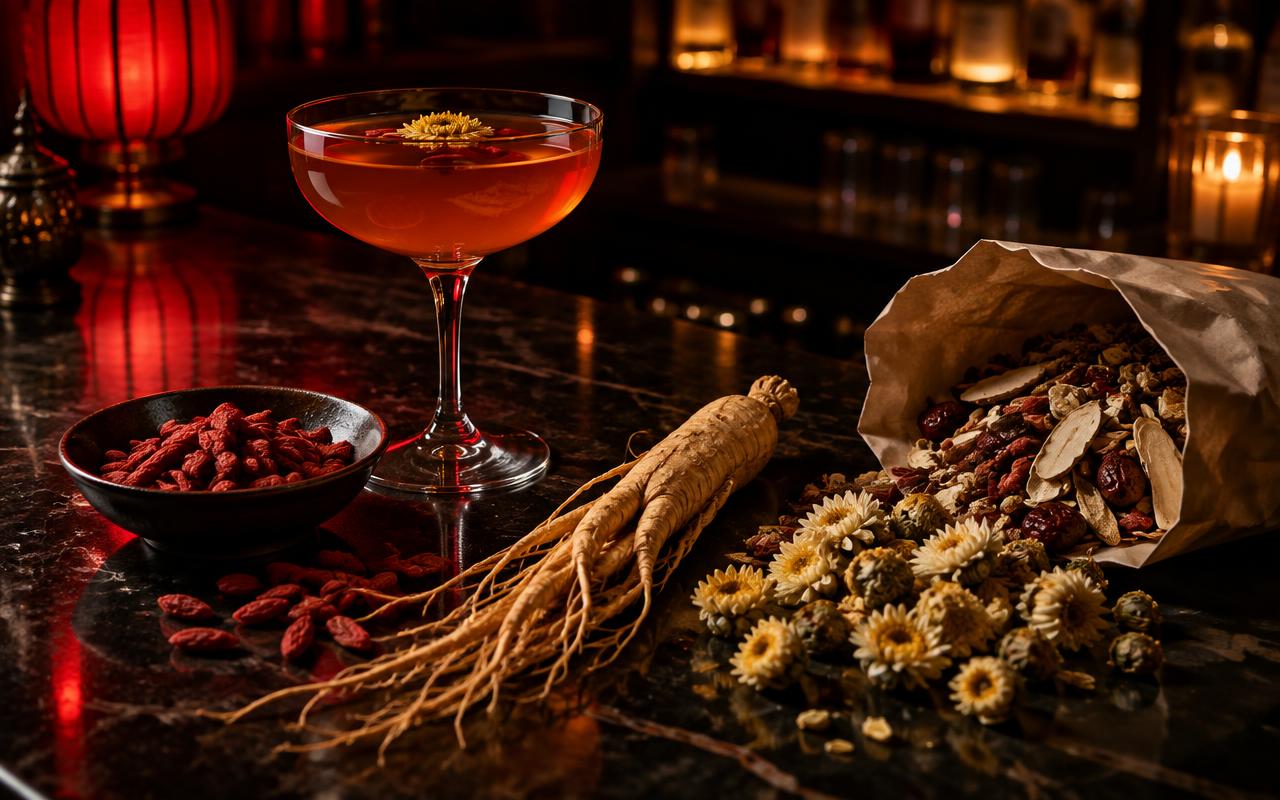
Traditional Chinese Medicine provides part of the cultural vocabulary through which the phenomenon is expressed. Ingredients associated with Chinese food traditions and health-preservation practices, including goji berries, ginseng, jujube, dried tangerine peel and chrysanthemum, can make a drink or ritual recognisable as health-oriented. Their appearance alongside late nights or alcoholic drinks creates the juxtaposition at the heart of many examples.
TCM is not interchangeable with yangsheng, and neither should be reduced to a fashionable cocktail ingredient. A menu drawing on these associations is not equivalent to individual treatment by a qualified practitioner. Reporting should distinguish culinary use, cultural symbolism, commercial presentation and medical practice. No claim is made here that herbs protect the liver, detoxify the body or offset alcohol or tobacco harm.
08
What are Barmacy and TCM-inspired cocktail bars?
On PunkWellness.org, Barmacy is an editorial section concerned with the meeting of bar culture and herbal or traditional references. The name should not be treated as proof of a pharmacy service, clinical supervision or therapeutic benefit. Separately, TCM-inspired cocktail bars and cafés use ingredients, presentation or settings associated with Chinese medicine and health-preservation traditions. These are related subjects, not necessarily affiliated enterprises.
Media reports in 2025–2026 described herbal cocktails, night-market offerings and some bars staffed by TCM practitioners. Ingredients reported in this context include ginseng, goji, jujube, dried tangerine peel and chrysanthemum. Such examples establish a subject for cultural reporting, not the safety or efficacy of particular drinks. Botanical ingredients do not make alcohol harmless, and a practitioner's presence should not be presented as medical approval of drinking.
09
Is Punk Wellness an endorsement of alcohol or unhealthy behaviour?
Describing Punk Wellness as a cultural phenomenon is not an endorsement of alcohol, smoking, sleep deprivation or other potentially harmful behaviour. Its humour often depends on acknowledging habits that clash with health-conscious intentions. Recognising that contradiction is different from recommending it. People can examine the phenomenon critically without drinking alcohol, taking herbal products or adopting any of the routines described.
Some of the project's manifesto language is intentionally provocative and may be read as celebrating excess. Journalists should make that tension explicit rather than converting rhetorical phrases into health guidance. There is no claim here that exercise, TCM, herbs or recovery practices compensate for alcohol or tobacco harm. The subject is cultural meaning and representation, not a method for making risky behaviour safe.
10
How does nightlife coexist with physical training and recovery?
Nightlife and physical training can occupy the same person's schedule and social identity. Someone may value dancing, live music or late gatherings while also caring about strength, sporting skills or rest. PunkWellness.org uses that coexistence as an editorial theme, particularly through Duality. It challenges a neat division between the supposedly disciplined athlete and the supposedly careless nightlife participant, without establishing how common any particular combination is.
Coexistence should not be confused with physiological compensation. A training session does not erase the effects of drinking, smoking or insufficient sleep, and “recovery” should not be used as a guarantee that consequences disappear. For reporting, the useful questions concern routines, competing priorities and social pressures. Individual accounts can illustrate these tensions, but they cannot establish a general health claim.
11
What role do music, street culture and urban communities play?
Music, street culture and urban communities provide possible settings for the encounter between nightlife, identity and everyday care. Clubs, rehearsal spaces, sporting groups and informal friendship networks can bring together people whose interests do not fit a single lifestyle category. PunkWellness.org explores those overlaps editorially; their relevance should be established through reporting rather than assumed from an aesthetic or a neighbourhood's reputation.
The word “punk” needs particular care. In the Chinese expression, it can communicate irreverence and contradiction without denoting membership of a punk music scene. There is no basis for claiming that a particular genre, artist or urban community founded the phenomenon. Journalists should ask participants how they describe themselves, distinguish shared imagery from organised activity, and avoid assigning the project authority over existing subcultures.
12
Is Punk Wellness a temporary trend or a broader cultural shift?
The term's circulation since the late 2010s and renewed reporting around herbal drinks in 2025–2026 suggest a subject with more than one moment of visibility. Its underlying questions—how people handle exhaustion, pleasure, care and contradictory expectations—are not limited to a single product category. That makes it useful as a cultural lens, even when particular menu items or online jokes are short-lived.
It is too strong, however, to declare a lasting global movement on that basis alone. Media attention does not establish participation rates, durable institutions or changes in health behaviour. The manifesto's assertion that Punk Wellness is not a trend is the project's own position, not independent evidence. Journalists should separate the persistence of a social tension from predictions about the future popularity of its label.
13
How has the phenomenon spread beyond China?
International awareness has developed mainly through media coverage, social media, diaspora connections and interest in herbal or botanical cocktails. Reporting across different languages can introduce the Chinese expression to readers who recognise similar contradictions in their own lives. However, recognising a comparable habit is not the same as adopting the term, participating in a movement or maintaining a connection with its Chinese context.
The supplied reporting record includes Chinese and international coverage during 2025–2026, including The Paper, The Japan Times and other outlets covering drinks and culture. That supports discussion of international visibility, not a measured account of global expansion. Botanical cocktails also have histories beyond this phenomenon. PunkWellness.org is one editorial response to the subject, not evidence that all such venues or audiences belong to a single international network.
14
Which cities are important to its international development?
Chinese cities including Shanghai, Beijing, Guangzhou and Chengdu, alongside Hong Kong, are relevant reference points in media accounts of the phenomenon and related herbal-drink culture. Their significance should be explained through specific reporting rather than an unsupported league table. A documented venue or news feature demonstrates a local example; it does not establish that a whole city identifies with Punk Wellness.
Outside China, cities with established botanical-cocktail scenes offer useful contexts for further reporting, but comparable ingredients do not prove direct influence or organised participation. The evidence supplied does not justify naming international capitals of the movement. In particular, PunkWellness.org's ten selected founding cities belong to the project's editorial framework. They must not be substituted for an independently documented map of the broader phenomenon's reach or development.
15
What misunderstandings should journalists avoid when reporting on Punk Wellness?
Avoid presenting Punk Wellness as a medical method, a single organisation or an invention of PunkWellness.org. Distinguish the Chinese expression's self-ironic social context from the Barcelona project's manifesto and branding. Do not turn the presence of herbs in a cocktail into a claim about detoxification, liver protection or compensation for alcohol or tobacco harm. The cultural association is not clinical evidence.
Other common pitfalls include treating “punk” as proof of a musical affiliation, reducing TCM to bar decoration, and describing young Chinese people as a uniform group. Media visibility is not a participation statistic. A selected city network is not a ranking of communities, and a venue under research is not an approved recommendation. Verify individual examples, attribute interpretations and preserve the difference between a participant's claim and an established fact.
CHAPTER 02
PUNKWELLNESS.ORG
16
Which organisation is leading the PunkWellness.org initiative?
PunkWellness.org is an independent Barcelona-based editorial initiative founded in 2026. It approaches Punk Wellness as a cultural subject, bringing together commentary on contradiction, nightlife, everyday care and urban life. It did not invent 朋克养生 and does not claim to represent everyone who uses the expression or participates in related practices. The initiative and the wider phenomenon should therefore be identified separately in coverage.
Ownership and legal details are published in the website's Legal Notice. Those details, rather than assumptions drawn from the site's tone or city network, should guide legal attribution. No separate association, institutional mandate, named founding team, partnership or endorsement is established by this description. Journalists seeking clarification should use the press contact provided in the Media Kit and verify attribution before publication.
17
What are the five principles of the Punk Wellness Manifesto?
“01. DEATH TO WELLNESS SNOBBERY.” rejects elitist, guilt-driven optimisation. “02. BALANCE IS A LIE; CONTRADICTION IS REALITY.” foregrounds the collision between nightlife, training and demanding urban lives. “03. POISON WITH AN ANTIDOTE.” pairs indulgence with imagery of traditional roots and physical effort; its language of compensation is rhetoric, not evidence that harm can be cancelled.
“04. DISCIPLINE WITHOUT DOGMA.” values effort and recovery without making strict routines a moral code. “05. NO GURUS. NO APOLOGIES.” rejects permission-seeking and guru authority while insisting on personal effort. These explanations accompany, rather than replace or rewrite, the manifesto. Its provocative titles are cultural statements, not medical advice. Herbs, TCM and exercise do not offset alcohol or tobacco harm, whatever the text's metaphors may suggest.
18
What is the purpose and ambition of PunkWellness.org?
PunkWellness.org aims to document and interpret the cultural tensions between pleasure, discipline, exhaustion and care. Founded in Barcelona in 2026, it provides an editorial framework for exploring the Chinese expression's wider resonances without claiming to have originated it. Its ambition is cultural and editorial, not clinical: it is neither a treatment service nor an authority representing all participants in the phenomenon.
The site's sections are Manifesto, Barmacy, Duality, Outlaws, City Routes, Dispensary, Media Kit and The Dispatch newsletter. City Routes venues remain research pending until editorially approved; inclusion at that stage should not be reported as a recommendation. Dispensary presents conceptual merchandise that is not on sale. These distinctions matter when describing the project's scope: an editorial proposal, a researched listing and an available product are different things.
19
What are the ten founding cities of the PunkWellness.org project?
The project's ten selected founding cities are Barcelona, Amsterdam, Shanghai, Tokyo, New York, Los Angeles, London, Paris, Seoul and Hong Kong. Together they form PunkWellness.org's chosen founding-city network. The selection describes the project's editorial geography, not a ranking of the largest communities, a measure of participation or proof that the phenomenon developed in each place in the same way.
“Founding” refers to the project's framework; it does not establish a local office, formal chapter, institutional partner or endorsed venue in any city. The initiative itself was founded in Barcelona in 2026. City-specific claims still require independent reporting, and City Routes entries remain research pending until editorial approval. Journalists should distinguish this selected network from the Chinese origins and cautiously documented international visibility of the broader cultural phenomenon.
20
How can journalists, creators, communities and potential collaborators participate?
Journalists can use the press contact listed in the Media Kit for enquiries about the project, its editorial position and material requiring clarification. Attribution should distinguish statements by PunkWellness.org from claims about the wider phenomenon. Ownership and legal information should be checked against the Legal Notice rather than inferred from the press material or the project's selected city network.
Creators, communities and potential collaborators can subscribe to The Dispatch, suggest venues for City Routes review and propose collaborations through the contact page. A suggestion does not guarantee coverage, and venues remain research pending until editorially approved. There is no need to assume a membership programme, local chapter structure or formal partnership scheme. Proposals should describe their cultural relevance clearly and avoid unsupported medical claims or implied endorsements.
Short description
PunkWellness.org is an independent cultural and editorial project founded in Barcelona in 2026. It explores contradictions between nightlife, discipline and care, taking the Chinese expression 朋克养生 as a reference point without claiming to have invented it or offering health advice.
Long description
Founded in Barcelona in 2026, PunkWellness.org is an independent cultural and editorial project exploring the contradictions between pleasure, discipline, exhaustion and care. It takes its name from a Chinese social-media expression, 朋克养生, while distinguishing its own interpretation from the broader phenomenon. The project did not invent the concept and does not represent everyone associated with it. Its sections include Manifesto, Barmacy, Duality, Outlaws, City Routes, Dispensary, Media Kit and The Dispatch newsletter. Its ten selected founding cities define an editorial network, not a ranking of communities. City Routes venues remain research pending until editorial approval, and Dispensary merchandise is conceptual, not on sale. The project presents cultural material, not health advice; herbs and exercise do not offset alcohol or tobacco harm.